
In this guide
Most automation advice assumes new construction. Most houses are not new. Retrofitting is very achievable, but it rewards a different approach, and the main risk is paying twice for the same outcome.
Start with a discovery visit, not a product
What is possible in a finished home depends almost entirely on what is already in the walls and what paths exist between floors. That is not something anyone can assess from a product catalogue. A discovery visit establishes where the existing wiring runs, whether there is neutral at the switch boxes, what the panel looks like, and which routes exist between levels.
- Whether switch boxes have a neutral conductor, which decides lighting options
- Existing network cabling and where it terminates
- Routes between floors: chases, closets, mechanical spaces
- Panel capacity and where a rack could live
- What existing equipment is worth keeping
Sequence matters more than in new construction
In a new build everything happens at once. In a retrofit the order determines how much you spend, because some work opens surfaces that other work needs.
Network first
Everything else depends on it, and it is the work most likely to require opening walls. Doing it first means later additions have somewhere to connect.
Then control
The processor and the interface, so each subsequent system joins something rather than standing alone.
Then systems, by access
Group work by which surfaces have to be opened, so a ceiling is opened once rather than three times.
Programming last
Once everything is present, so scenes are built against the real system rather than reworked repeatedly.
Open a ceiling once. Not three times for three systems.
What retrofits well
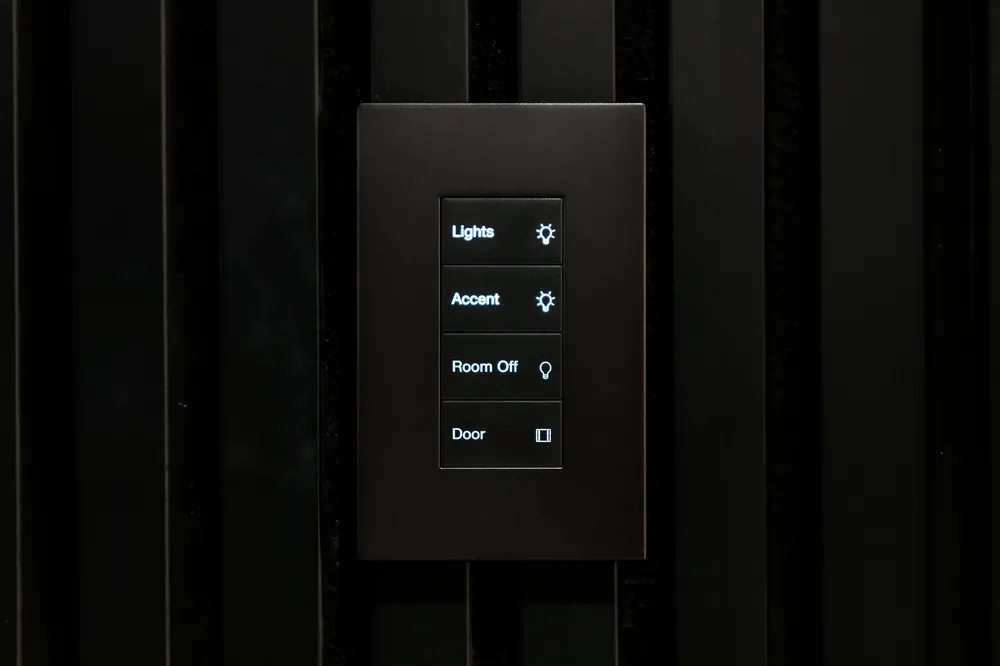
Often excellent, especially where switch boxes have a neutral. Keypads replace existing switches.
No wiring needed, which makes them the common retrofit answer.
Usually straightforward, with exterior runs the main variable.
Where there is a joist bay and a route, in-ceiling speakers go in well.
What is genuinely harder
- Wired speakers in finished ceilings with no route. Sometimes there is simply no path without opening the ceiling.
- Hardwired shades. Power at the window usually means opening the wall above it.
- In-wall touch panels. Need both power and network at a location that may have neither.
- Whole-house rewiring. Possible, but at that point it is a renovation decision rather than an AV one.
Phasing without paying twice
When a surface is open for any reason, pull everything that will ever need to pass through it. The cable is inexpensive. The access is what you are paying for, and you only have it once.
That applies to work that has nothing to do with AV. If a bathroom is being renovated above the room where you eventually want ceiling speakers, that is the moment to run the cable, even if the speakers are two years away.
Start with a walkthrough
We will look at what is already in the walls and come back with a phased plan in a sensible order.
Request a walkthrough