 Start a project
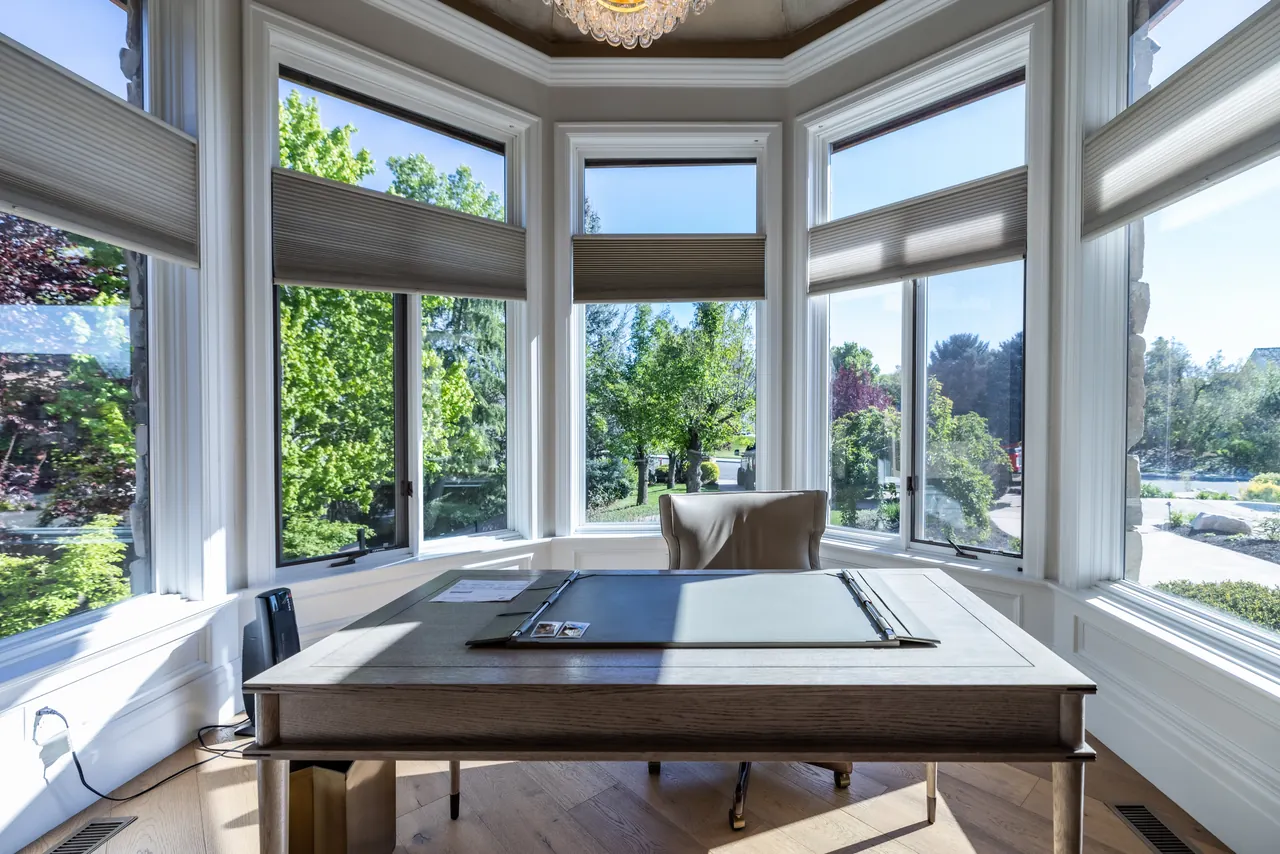
Motorized
shades.
Shades are priced per opening, which sounds simple until you count the variables inside each one. For Salt Lake City homes the decisions that matter are glare, privacy, how dark a room needs to get, and whether power can reach the window.
Interactive
Openness factor controls how much light passes and how much view remains. Move the slider.
Illustrative. Blackout fabric still passes light at the edges unless side channels or a pocket detail are specified.
Fabric openness decides how much light passes and how much view remains. A solar or screen fabric cuts glare and heat while keeping the view, which suits living spaces. A light-filtering fabric gives privacy and softens light without darkness. A blackout fabric blocks light through the fabric itself.
Blackout fabric alone does not make a dark room. Light comes around the edges as well as through the fabric, so genuine darkening needs side channels or a pocket detail, planned with the window rather than added afterwards.
Battery shades need no wiring, which makes them the common answer in finished homes. The trade is that batteries need recharging or replacing, and that means being able to reach every shade.
Hardwired shades have nothing to recharge and are the right answer for high or hard-to-reach openings. They need power at the opening before finishes, which makes this a decision for the construction phase rather than afterwards.
Width matters more than height. A wide shade needs a larger tube and a stronger motor to avoid deflection across the span, and past a certain width the correct answer is two shades that move together as one.
Measurement is where shade projects go wrong, because shades are manufactured to the measurement supplied. Who measures, and when, should be settled explicitly before anything is ordered.
Shades on their own remote are a product. Shades that drop when a projector starts, lift at sunrise and appear on the same keypad as the lighting are part of a system. The hardware can be identical; the difference is the control layer.
Where you already have a smart-home system, compatibility is assessed rather than assumed. Tell us what you have and we will establish what is supported.
Window count and size, fabric selection, power method, mounting detail, installation access and programming. A pocket detail that hides the shade in the ceiling is a construction item coordinated with the builder and it changes both cost and result.
Common questions
Not necessarily. Battery-powered shades need no wiring at all, which is why they are common in finished homes. Hardwired shades need power at the window head and are generally specified during construction. High or hard-to-reach windows are the usual case for hardwiring regardless of stage.
Often, and it depends on the protocols both sides support. Rather than promise compatibility with a system we have not seen, we establish what you have during the consultation and tell you what will integrate and what will not.
Solar or screen fabric reduces glare and heat while keeping the view, which suits living spaces. Blackout fabric blocks light through the fabric for bedrooms and media rooms. Worth knowing: blackout fabric alone still lets light around the edges, so a genuinely dark room needs side channels or a pocket detail as well.
Serving Salt Lake City and the Wasatch Front, with projects in Park City, Provo and St. George. Coverage elsewhere in Utah is confirmed per project. Residential systems · All services
Next step
Tell us roughly how many windows and their sizes, what each room needs from the shades, and whether power is available at the openings.