 Start a project
Home
automation.
Integration is the decision to have lighting, shades, audio, climate, cameras and access behave as one system rather than six that happen to share a house. Across Salt Lake City and the Wasatch Front, that decision changes the infrastructure, not just the app.
Interactive
This is what a scene actually does. Press one and watch the house respond, in the order the system executes it.
A scene is not a light switch with a nicer name. It is a sequence the system executes across several subsystems at once, and it only works if the devices involved were specified together.
Arrival, evening and away are the three most households actually use. Arrival brings up path lighting and unlocks what should be unlocked. Evening settles the lighting, drops shades for privacy and arms the exterior. Away confirms the house is shut down rather than guessing.
Entry and path lighting, shades to privacy, climate to occupied, exterior cameras to active.
Lighting to warm levels, shades down, audio where you are, doorbell to quiet hours.
Lighting off, shades closed, climate setback, cameras to away mode, doors confirmed.
A control processor is the piece that makes a group of products into a system. It holds the logic, it runs locally, and it is what lets a keypad in the kitchen change something in the theater.
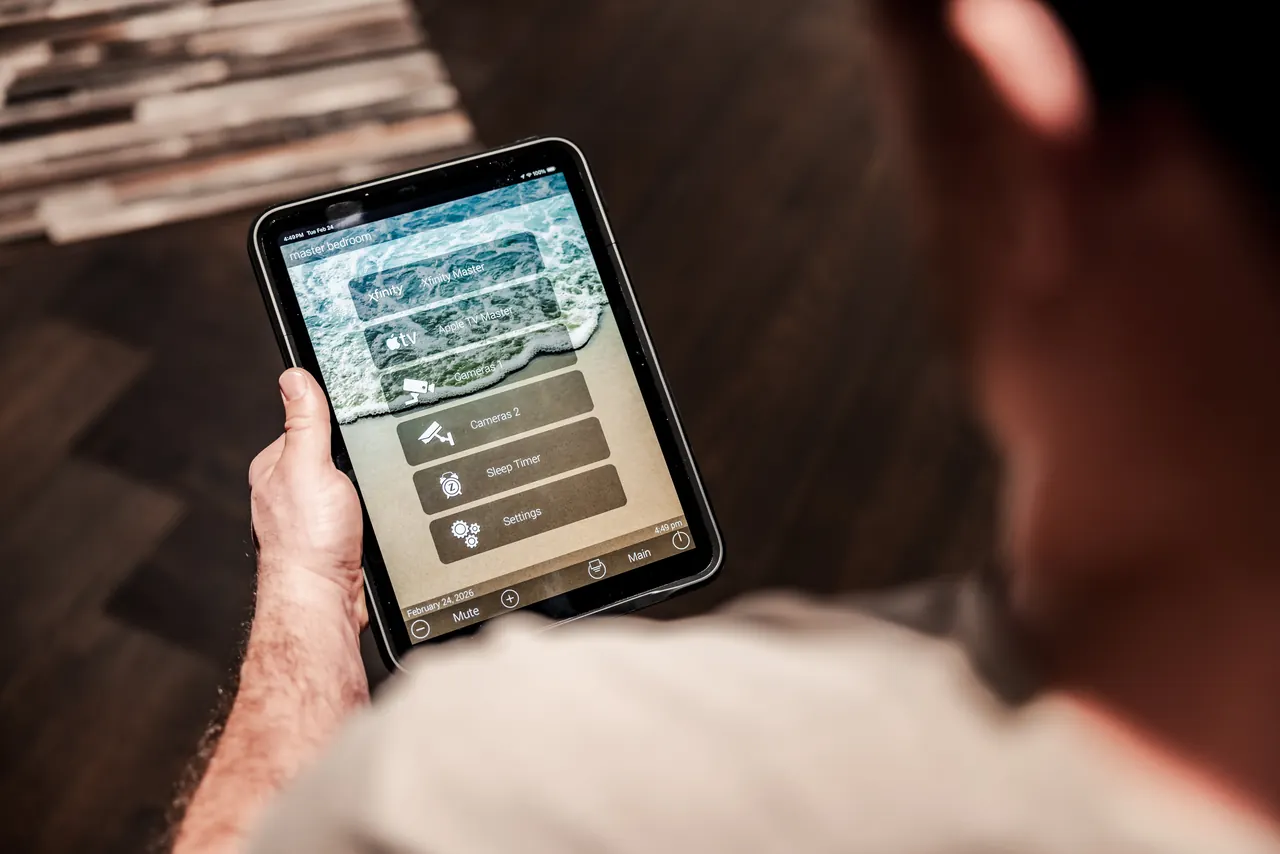
Keypads handle the things you do every day without reaching for a phone. The app handles everything else, and remote access when you are away. Both show the same system, named the same way.
In a new build the work happens on paper before framing. Pathways, keypad boxes with a neutral conductor, rack location, and conduit for whatever comes later.
In a finished home the sequence matters more than the products. Network first, then control, then each system grouped by which surfaces have to be opened, so a ceiling is opened once rather than three times. Discovery establishes what is already in the walls before anything is specified.
Scenes, keypads and local control keep working when the internet does not, because the logic runs on a processor in the house. What stops is remote access from outside, cloud voice services and streaming sources.
Handover is part of the installation rather than an afterthought: user accounts and permissions agreed, documentation provided, and a session with the people who actually live there.
Four things move the number more than the hardware list does: how many systems are integrated, whether walls are open, the processor capacity the house needs, and the depth of programming and commissioning.
Commissioning is the line most often missing from a cheaper quote. Testing every scene in every room takes time, and a system that was never commissioned finishes unfinished.
Common questions
Often, and discovery establishes it before anything is promised. It depends on whether the equipment exposes a documented control interface. We will tell you plainly when something is not worth keeping rather than building around it and charging you for the workaround.
Keypads, scenes, lighting, shades and local audio keep working, because the processor runs the logic inside the house. Remote access from outside the house, cloud voice assistants and streaming services need the internet by definition and will not.
Yes, and in a finished home that is usually the sensible approach. The rule that saves money is to pull everything that will ever pass through a surface while that surface is open, even if the equipment is two years away. The cable is cheap; the access is what you are paying for.
Serving Salt Lake City and the Wasatch Front, with projects in Park City, Provo and St. George. Coverage elsewhere in Utah is confirmed per project. Residential systems · All services
Next step
Tell us whether this is a new build or an existing home, which systems you want integrated, and the project city.