 Start a project
Podcast and
broadcast studios.
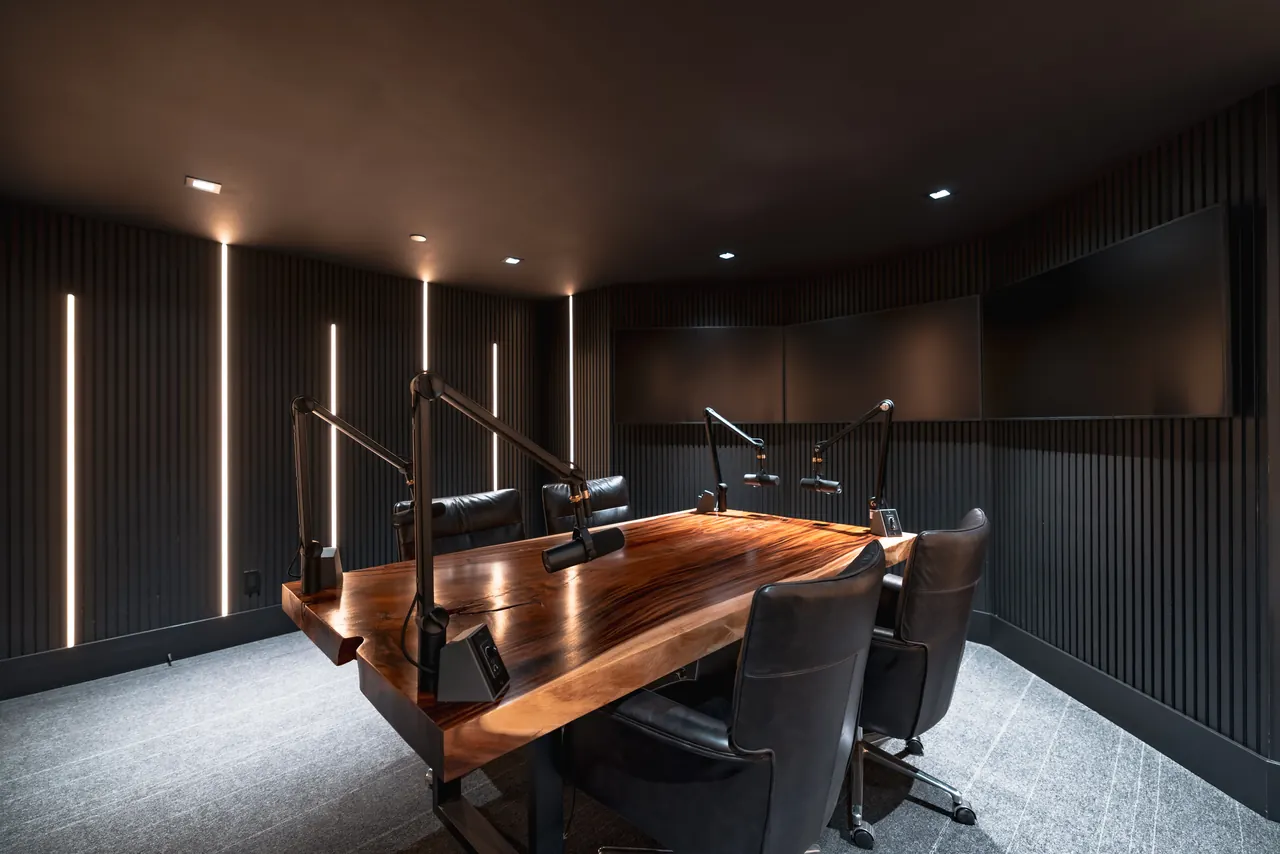
We design and build permanent studios for Salt Lake City businesses. This is a construction and integration service rather than a rental: a room your team walks into and uses on a schedule without a production crew present.
Interactive
Press a stage to follow the signal. The same room can record and edit later, or switch live.
Host and guest count determines the room before any equipment is chosen. A two-person studio and a four-person studio are different rooms, not the same room with more chairs, because position count drives microphone count, camera angles, table size and treated surface.
Whether the output is audio, video or both changes the lighting, the camera plan and the storage requirement. Who operates it changes everything else.
Acoustic treatment addresses reflections inside the room and can be added at any time. Sound isolation addresses noise entering or leaving and is a construction decision involving mass, decoupling, sealing and duct design.
In an office shell the harder problem is usually mechanical noise. HVAC designed for airflow rather than quiet puts rumble into every take, and resolving it is a conversation with the building and the mechanical contractor that belongs early.
Camera positions, audio capture, lighting and return displays are one room design rather than four purchases. Studio lighting is fixed so that every episode matches, which matters more than any single episode looking good.
Service access is part of the design. A rack that cannot be reached without dismantling the set is a problem you discover in month three.
Recording and editing afterwards is cheapest to build and most flexible, but needs someone to edit every episode. Live switching costs more and finishes the episode when recording stops. Recording isolated feeds while switching live preserves both options at the cost of storage and cabling.
The decision should follow staffing rather than preference.
Design, installation, test recordings with the actual team, operator training and documentation. The deliverable is a room staff can run, which means an operating guide with pictures rather than a manual.
Cost drivers are room condition, isolation requirements, position count, camera count and whether live switching is in scope.
Common questions
Usually, and the room choice matters more than its size. Pick the quiet one: walk candidates listening for HVAC with the system running, corridor and kitchen noise, plumbing in adjacent walls, and street noise at the time of day you will record. Treatment can be built; quiet is harder to retrofit.
They are different things. Treatment fixes how the room sounds and can be added later. Soundproofing stops noise getting in or out and is largely a construction decision. Most office studios need treatment and some mechanical noise work; full isolation is only necessary where the surroundings demand it.
That should be the design goal, and it is achievable. One control to start the room, fixed positions so nothing needs adjusting per session, unambiguous recording indication, and files landing somewhere known without anyone exporting them. A studio that needs a technician present gets booked around that person and eventually falls out of use.
Serving Salt Lake City and the Wasatch Front, with projects in Park City, Provo and St. George. Coverage elsewhere in Utah is confirmed per project. Commercial systems · All services
Next step
Tell us the host and guest count, whether the output is video or audio, and what you want to do with recording and streaming.